My intent is to allow the reader to walk down the lanes of old London (before it burned to the ground in the Great Fire of 1666) and feel as if you are actually there. You can smell and touch the nuances of London. You'll know what it's like to work your way through the City and its the conflicting laws where religion played in important part of everyday life. So sit back and enjoy the ride.

Oh, and then there's my French Revolution novel.
Showing posts with label London Fire. Show all posts

Wednesday, November 5, 2014

Old St. Paul's


When I find historical texts published in the middle of the 17th century I feel I’ve won the lottery. Even though most authors of this time-frame write flowery 'epistles', or a long convoluted 'introduction to the reader', interspersed with Latin or other languages (Greek comes to mind) which I cannot read, once I finally get into the heart of the book, it yields great information.
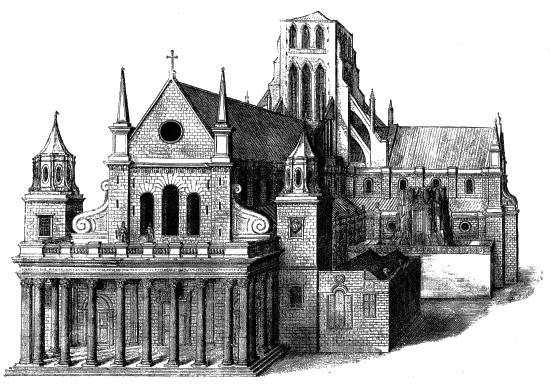
St Paul's in the early years

Lately, I've run into historical texts about the physical condition of London’s old St Paul's Cathedral. The information is very interesting in that the old fellow lived a full life. The great church could have regaled us with stories from the blessed to the morbid. When the cathedral finally met his demise, he went down in a blazing coat of fury.

Surprisingly, for a good while it was a crumbling piece of rubbish, both structurally and spiritually. After reading, I really wonder if Godly services ever took place in the building.  

In 1658 William Dugdale published The History of St Paul’s Cathedral, and dedicated it to The Right Honourable Christopher Lord Hatton, Comptroller for the Household to the late King Charles (the first), and one of his majesties most honourable Privy Council. Mind you, this was during the Interregnum when Cromwell was in power. A year prior, no one would have attempted to do dedicate a book to a Royalist, but by this time, the underpinning of the Commonwealth was already weakening, as was the Puritan leader's health. Cromwell died in September of this same year, a catalyst to restore the Royal Stuarts. Times were definitely a' changing.

A short history: The cathedral build began in 1087 and took 200 years to finish. In 1255 part of the church was lengthened, which swallowed up St Faith, a nearby parish church. The parishioners were given space in Paul's crypt (called St Faith under St Paul’s) where booksellers and their families worshiped. Toward the end of Paul’s life, as a safety precaution, St Faith was used as storage space for their books/papers/printing presses.
St Paul's after the 1561 fire
In 1561 lightning struck St Paul’s spire where it caught fire and fell through the roof of the nave. The fire melted the cathedral bells, and lead covering the spire melted off the roof like molten lava. Queen Elizabeth sent letters to the Lord Mayor, pleading for a quick repair to the roof. She donated from her own purse 1000 marks, and lumber from her woodlands. Almost 7,000l were allocated. Within a month of the fire, they began to rebuild the roof, hastily covering the wood with lead. The spire was never replaced, the reconstruction of the roof poorly done, yet this still took 5 years to complete. 

As a result, St Paul's continued in ill-health for the next 60 years. Inigo Jones was given the task to refurbish the great, moldering cathedral while under King James I, but squabbles broke out regarding the architectural style, and money became scarce. Nothing happened for another 8 years. Then King James died.

Under Charles I, reconstruction was again attempted. This time, all donated monies were to be recorded, with instructions on what to do if a donor died without a will. The committee to rebuild the Cathedral would still get their money. Contributions flowed into London. The renovations became one of national pride. Over 10,000l had been gathered. By the end of 1632, repairs began. By the end of 1639 almost 90,000l had been collected. Houses around Paul's were demolished to make room for the reconstruction. Money was handed out to those who lost their homes; donations continued to flow in, sums were divvied for the repairs, then in 1641, everything came to an abrupt halt.

Civil wars engulfed the country; King Charles was at war with his own people. Parliament men, and their followers, defaced churches, including St. Paul's. The cavalry stabled their horses in the church, pulled down Paul's cross, and other crosses around the city and country. King Charles I was executed, and Oliver Cromwell moved into Whitehall Palace.

During the Puritan era, in Dean Milman's words, '...St. Paul's became a useless pile... The portico was let for mean shops... The body of the Church became a cavalry barrack.' The roof began to leak.

Paul's Walk as Wenceslaus Hollar would have it.
Then there was Paul's Walk.
As far back as the 14th century, abuses abounded in St Paul's, which seemed no one had enough power to stop. The nave extended the length of the Cathedral. It was long and vaulted, open to the public during all hours of the day and night. It became a sheltered shortcut across the churchyard, a meeting place for all and sundry, a marketplace of sorts. Young men threw stones at birds that nested there; some hurled arrows from crossbows, breaking statues and windows. Servants out of work gathered at a pillar to make themselves known they were for hire. Fights and brawls further sent the Cathedral into decline. The authorities tried to stop these transgressions through excommunicates and whatnots. By the 17th century, the governments were in disarray, and the abuse continued. St Paul’s nave remained a place of London's underbelly, especially at night.

Charles II returned to England in a blaze of joy and celebration May 1660. In 1663, a scaffold was built around St Paul's, money collected, and more houses designated to be pulled down in order to make room for the rebuild. Architectural design was again argued. A committee of commissioners had a meeting on August 25, 1666. The repairs would be extensive from the old foundation to the pillars up to the roof. The steeple still had not been replaced from the 1561 fire, and a new one fell into the discussions.

But before anything could be done, a fierce wind blew, and in the early hours of September 2nd, 1666 a fire started in a bakery on Pudding Lane. Flames blew with the winds and spread at a rapid rate, burning almost everything within the old London walls. St Paul's, too. 

The scaffolding and other demolition around Paul's hampered any fight to save the old building. Its disrepair only fueled the fire. St Faith's under Paul's was loaded with combustive goods that exploded, sending Paul’s choir into St Faith. The lead surface of the roof began to melt in folds and rained down the sides of the church, into the streets. Within hours the great Cathedral was a cavernous loss.

St Paul's after the fire of 1666
I guess all good things must pass. St Paul’s lasted for centuries, mostly in some sort of disrepair. Sad, really.  

Many thanks to:
Dugdale, William. The History of St Pauls Cathedral in London from its Foundation until these Times: Extracted out of Originall Charters. Records. Leiger Books, and other Manuscripts. Beautified with sundry Prospects of the Church, Figures of Tombes, and Monument. London 1658.
Longman, William (F.S.A). A History of The Three Cathedrals, dedicated to St. Paul in London. London 1873
Simpson, W. Sparrow (D.D., F.S.A). Chapters in the History of Old S. Paul’s. London 1910.

You can find my novels here: http://www.amazon.com/Katherine-Pym/e/B004GILIAS


Friday, April 18, 2014

Meet My Main Character


I’ve been tagged by Linda Root & Anita Seymour Davison to tell you about the main character in one of my writing projects, but I really can't do that. I finished The Barbers, and my WIP is now just being born. Instead, I'll tell you a little of my 'Plan'...

Back in the day (a Texas colloquialism great grandparents used) I found Samuel Pepys. Upon reading his journal I realized it was a discussion of local mores, slang, and his life saturated in current events that were so minute, so abbreviated, I couldn't make heads nor tails of it. My understanding of the mid-17th century was nil, and what Mr Pepys wrote in his journal felt like jumping into a whirling chasm filled with bits and bobs only the locals of the time understood.

So, I had to learn of what his journals said, i.e., the life of one living in the 17th century who'd endured the English Civil Wars, and the Restoration, the 1st & 2nd Anglo/Dutch Wars, the death of King Charles II and subsequent exile of James II, then of course, the insane Titus Oates escapade.

I studied London City and its Liberties. I packed my library with all sorts of historical texts filled with random pieces of information my heirs will most likely give to used book stores, or the Goodwill. I mean, not many care about the history of beds or shoes and Livery Companies, the microscope Robert Hooke had made, or that he felt veins and capillaries meant something important. 

For The Barbers I found lovely 17th century published texts that helped my story roll along the foggy lanes of London, on medicine and science, even an experiment on a dog. It was soooo exciting.

My Plan, therefore, is to write of the volatile 1660 decade until London burns to the ground. Each novel will take place in London during one year due to the amazing amount of current events. So far, I’ve managed to write the years 1660-1663. 

My birthing project (Chapter 1 is always painful) is of London 1664. That manuscript has yet to take on a personality of its own. In the interim I’ll tell you of The Barbers, and my protagonist, how she deals with life in general.

 What is the name of your character? Is he/or she fictional or a historic person?
My character's name is Celia Barber, a fictional person. She apprenticed as a barber under her father, and enters the guild (Barber-Surgeons), but as a woman she will never be licensed. (There are some documented cases of women holding licenses outside the 7 mile radius of London, but not within the city proper.) Celia shares a shop with her father who snips hair & shaves chins, while she heals. It is against the guild to be a barber and do the work of a surgeon or physican. King Henry VIII separated the barber/surgeon job functions, which weren't often adhered to, but I digress.

When and where is the story set?
The story is set in London 1663.

What should we know about him/her?
Celia Barber is very interested in science and medicine, and she chafes at the restrictions set against women.

As religious strife settles down, the great brains of England begin to explore medicine and science. Celia strives to see a dissection in the Hall of Surgeons, and an experiment in the Royal Society, but her dreams far outreach reality.

Celia's sister works at the Palace of Whitehall and introduces her to Viscount Deeping, who takes an immediate 'shine' to Celia. He enjoys her quest for knowledge, her dreams to see an experiment at the Royal Society. He takes her there as his lackey where Celia is thrilled to meet Robert Hooke, who created so many tools for the scientist, and wrote theses for the physician.

What is the main conflict? What messes up his or her life?
Her mother is narcissistic, and as a toddler ignores Celia. Finally, when she is about three or four, her mother casts Celia to the streets with a pronounced slam of the door. Her father rescues her, but the rejection takes its toll. Celia never trusts anyone; she'd rather keep to the shadows with her thoughts and dreams, which were many, but life intervenes. She loses one brother, than another, and she can't save them.

What is the personal goal of the character?
To heal people the best she can with local herbs and the latest science, but her goal is sidetracked when her impudent sister sees an inkling of treasure, and the intrusive viscount.

Is there a working title for this novel? And can we read more about it?
The title is set in cement, and the work published. The Barbers, a Tale Most Curious & Rare. 

When can we expect the book to be published?
It’s on the cyber shelves as we speak, paperback and ebook, on amazon, almost all countries. 
Many thanks to Linda and Anita for inviting me on this trip of how my historical fiction develops of itself (after tons of research, that is).

Please click on the links below for The Barbers
USA
UK 

For my other novels, see amazon: http://www.amazon.com/Katherine-Pym/e/B004GILIAS

Monday, September 23, 2013

17th Century Whitehall


This blog is in celebration of the release of Castles, Customs, and Kings, True Tales by English Historical Fiction Authors. It’s actually bits and bobs from the Historical Fiction Authors Blog, that sparked the interest of authors as they did research for their novels. This book includes a few of my tidbits. CC&K has a plethora of articles that you can read in one sitting. It will enlighten you, and enhance your day.

To get you going on how exciting the Castles, Customs, and Kings will be, I’ll give you some history on Whitehall Palace, which is no longer in existence. Nothing remains but the Banqueting House.

Whitehall Part I, A quick history:
In the 13th century, Whitehall was called York Place. It was not a palace, but a mansion built by an archbishop between the cities of Westminster and London. It wasn’t too large then, but over the centuries, its owners added to it which accommodated kings, queens, and their entourages when they visited York Place. 

Old Whitehall

By the 16th century, in the reign of King Henry VIII, Thomas Wolsey, Archbishop of York, lived in it. He had expanded it to such a degree that it rivaled most of the king’s palaces. Besides the fact Wolsey was Catholic, and Henry now rebuked Catholics, to have a minion with a larger house than he did not sit well. King Henry stripped Wolsey of all power, then moved into York Place and renamed it Whitehall.

King Henry made his own changes. He updated it until it encompassed 23 acres and was the largest palace in Europe. He erected merriment buildings that included a cockpit (turned into a theatre during King Charles II), tennis court, and a tiltyard. There was the King Street Gate and Holbein Gate that allowed the Court to traverse from Whitehall to St James’ Park without ever crossing a public road.

Each king or queen after Henry VIII added to Whitehall until in 1660 when King Charles II took residence there, it had become a rambling jumble of chambers, passageways, and staircases connected by uneven floors that amounted to more than 1,500 rooms. It was also a montage of architectural designs.
A view of Whitehall from the Heavens

During Queen Elizabeth I’s time, the first of the Banqueting Houses came into being. Elizabeth I had a large chamber built of timber and canvas to house entertainments. It occupied the site of the current Banqueting House, until James I commissioned Inigo Jones to build a solid structure, which replaced the aging, and dilapidated building. This new one was completed by the end of his reign. It was large with windows on all four sides, balconies, and an undercroft that took up the entire base of the building.

King Charles I commissioned Rubens to paint the Banqueting House ceiling. He was given £3,000 and a gold chain for the effort. Rubens painted the canvases and sent them to England for installation on the ceiling, which finished in 1635.

Rubens’ work effectively put the Banqueting House out of business. It was feared smoke from torches and candles would damage the splendor, so a new reception room was built. Erected beside the Banqueting House, from this moment on most ceremonial functions took place here.

Charles I was executed on a platform outside the Banqueting House. After this, Whitehall Palace emptied out during the Civil Wars, but once Cromwell became the new sovereign, Whitehall filled up, again. After Cromwell’s death, what remained of the Rump Parliament tried to sell the ramshackle palace.

Then, with the Restoration of King Charles II, Whitehall became alive. As with his father and grandfather, Charles II wanted to make changes to the already sprawling palace. He hired Sir Christopher Wren to make it more like Versailles, but the planning never came to fruition. 
After Charles II died, King James II made changes in the forms of bettering his wife’s apartments, and adding a new chapel. By the time William III & Mary II took up residence in Whitehall, its importance was on the decline. King William suffered from asthma. The palace sat on the banks of the Thames; it was drafty and damp. He preferred Kensington Palace. By Queen Mary’s death in 1694, Whitehall was rarely used, and the Banqueting House had tuned into a storage facility.

In 1698, the great rambling palace of Whitehall burned to the ground. The only structures that remained were the Banqueting House, the Holbein and Whitehall gates. Today, only the Banqueting House still stands.
King Charles II Whitehall

Whitehall Part II, Other stuff which includes fire:  

Castles had a tendency to be drafty, and it was no different with the Palace of Whitehall. Due to the compilation of various buildings crammed together, the palace was more drafty than others. During storms, winds whistled down chimneys and spread ash across the chambers. Fires sparked then smoldered.

London and its suburbs used sea coal and brown coal to heat their homes. It was inferior and smoked. London also seemed to have existed under a pall of constant air inversion. Most days, smoke and pollution hung stagnant over the city and its environs.

Coal was used to brew ale or beer. Dyers used coal to heat water. Soap boilers manufactured their product with ash. They cooked their product over coal fires. Glass houses, founders and most industries used coal for their fires and their products. As a result, smoke settled heavy on everything with a gritty dust. It filled the air and it was hard to breathe.

John Evelyn (1620-1706) loved London. He observed everything within and without the great city. In 1661, he wrote Fumifugium: or, The Inconvenience of the AER, and SMOAKE of London Dissipate, a diatribe of the damages smoke can do to a person, city, and anything alive. In this pamphlet, he also proposed remedies to right the wrongs of this damage. Once done, he gave the pamphlet to King Charles II in the year of his coronation.

A visit to Whitehall provoked Evelyn to write the booklet. While he strolled through the palace, looking for a glimpse of His Royal Majesty, Evelyn said, “a presumptuous smoke issuing from one or two tunnels near Northumberland House, and not far from Scotland Yard, did so invade the Court that all the rooms, galleries, and places about it were filled and infested with it, and that to such a degree, as men could hardly discern one another for the cloud, and none could support, without manifest inconveniency. It was not this which did first suggest to me what I had long since conceived against this pernicious accident, upon frequent observation, but it was this alone, and the trouble that it must needs procure to Your Sacred Majesty, as well as hazard to your health…” 

I cannot imagine smoke filling a house to such an extent you can see only a shape of a person in front of you.

In 1662 a strong windstorm hit London, and Whitehall was not spared. A few fires started in that great complex but fortunately, they were doused without any real damage. After this, regulations were implemented to have at each hearth a leather bucket filled with water.

By 1691, Whitehall was a maze of complexity, and the largest in Europe. On April 10th of this year, a fire broke out that damaged a great deal of the structure, but not the State Apartments. It did not affect William III and Mary II, who now lived most of the time in Kensington Palace.

Then, in 1698, what remained of Whitehall was completely destroyed, along with many treasures garnered over the ages. Of them, it is thought Michelangelo’s Cupid, the Portrait of Henry VIII, and Bernini’s marble bust of King Charles I burned to ash.

John Evelyn wrote: “Whitehall burnt! Nothing but walls and ruins left.”

So it goes, we have another interesting blog that could very well be inserted in another book of stories by English Historical Fiction Authors.

This is the great new book
Now available at amazon
Giveaway pdf or mobi:

If 1660's London interests you, my latest release is titled Of Carrion Feathers, a novel of espionage during the reign of Charles II. There are some thrilling moments where my heroine and hero run amok through Whitehall Palace. 

Please leave a comment what excites you about English history, and I’ll throw your name in a hat for a drawing. Please leave an email address where I can contact you.

For more interesting blog hop English History, and giveaways:

~~~~~~~~ 

You can find my other novels in London during the 1660’s, please see:  

http://www.amazon.com/s/ref=nb_sb_noss_1?url=search-alias%3Ddigital-text&field-keywords=katherine+pym


I wish to thank the following sources:
Adrian Tinniswood. By Permission of Heaven, The true Story of the Great Fire of London. Riverhead Books, NY, 2003

John Evelyn. Fumifugium: Or, The Inconvenience of the AER, and SMOAKE of London Dissipated. Together With some Remedies humbly proposed by J.E. Esq; To His Sacred MAJESTIE, and To the Parliament now Assemble. Published by His Majesties Command. London 1661